Beneath the rich soil of Kogi West, vast deposits of gold, lithium, and other rich mineral deposits promise prosperity. But for the local communities, this mineral wealth has become a wave of insecurity, land grabbing, and fear that residents and security sources directly attribute to powerful political figures and their foreign proxies.
An investigation spanning several weeks, involving interviews with community leaders, security personnel, and mining experts, reveals a disturbing pattern: licensed and illegal miners, allegedly backed by prominent politicians, are suspected of arming bandits to terrorize local populations, driving them from their ancestral lands to allow for unchecked and highly profitable mineral extraction.
The Kogi West Blueprint: Politicians, Proxies, and Fear
The epicenter of this crisis is in the communities of Kogi West Senatorial District. Residents, who spoke exclusively on condition of anonymity for fear of violent reprisals, point fingers at a well-known network.
“The mining sites are not run by our people,” one community elder from Yagba West Local Government Area explained, his voice barely a whisper. “They are being done by proxy by some Chinese who are holding it for prominent Kogi politicians. Among them is a former Chief of Staff and a former Governor. They have the cover, and the Chinese have the machines. We have the suffering.”
The modus operandi, as described by multiple sources, follows a chillingly consistent script:
Mineral-rich communities are identified, often through covert surveying.
Large parcels of land are acquired through a combination of coercion, deceit, and the exploitation of poverty. Locals report being offered paltry sums for land they did not fully understand the value of.
For those who refuse to sell or who later protest, intimidation begins. This starts with threats and escalates to violent attacks by armed men who arrive on motorcycles, often in the dead of night.
Once the community is sufficiently terrorized and displaced, the mining operations begin in earnest. Heavy machinery, operated primarily by Chinese nationals, moves in, guarded by private security forces that locals view as an occupying army.
“Most of these lands were sold ignorantly and secretly,” lamented a youth leader from Yagba East LGA. “Our fathers were given crumbs for what they thought was barren land. They were told it was for farming. Now, we see trucks upon trucks leaving with our gold and that black stone [lithium]. When we try to ask questions, we are met with bullets.”
The state government has repeatedly announced initiatives to curb illegal mining, but residents claim these efforts are cosmetic, targeting only small-scale, local artisanal miners while leaving the large, politically-connected operations untouched.
A Disturbing Pattern: From Niger to Zamfara
The situation in Kogi West is not an isolated incident but part of a broader, more sinister pattern replicated across Nigeria’s mineral-rich regions.
Niger State: In areas like Shiroro, a direct nexus has been established between armed bandits and illegal miners. Bandits attack villages, killing and kidnapping locals, creating a security vacuum. They then offer “protection” to illegal miners operating in the seized territory, taking a cut of the profits. This creates a perverse economy where insecurity becomes a profitable business model for both the bandits and their sponsors.
Zamfara State: This state became the textbook case of the phenomenon. Illegal gold mining was so rampant and so deeply tied to armed banditry that the federal government declared a no-fly zone and implemented a full-scale ban on mining activities in 2019 to cut off the funding source for the terrorists. Despite this, reports persist of operations continuing under the protection of armed groups.
Katsina and Kaduna States: Similar reports echo from these states, where communities accuse “outsiders” of collaborating with bandits to dispossess them of their land, particularly gold-rich areas.
In each case, the playbook is the same: use violence to create fear and displacement, then move in to exploit the resources. The profits from this illegal trade are then used to purchase more weapons, fund more attacks, and bribe officials, creating a vicious, self-sustaining cycle of violence and exploitation.
Land Grabbing: The Arm-twisting Tactics of Economic Terrorists
A sad case of land grabbing is the ongoing legal dispute by Iddo-Ojesa community in Yagba East local government with Relix Mining Company Limited (Chinese company) who through alleged wrong negotiation with Joshman Multiconcept Limited (Nigeria Company owned by current Chairman of Yagba East LGA) and other impersonators reportedly swindled an unsuspecting Chinese company in the fraudulent purchase of a large expanse of land that is up to a quarter of the entire LGA!
On the 17th of January 2023, a consent was signed between the Omo Meru Family of Iddo Ojesa community and Joshman Multiconcept Company, owned by the current Chairman Yagba East Local Government Area, Mr Dare Joshua, for a mining exploration licence covering a small portion of the family land.
Mr Dare’s company failed to stick to earlier agreement by selling the entire Meru family land to the unsuspecting Chinese company (Rellix Mining Limited) aided by unscrupulous representatives of Meru’s family and others who appended their signatures to the illicit deal without the consent of the family head and other principal members of the family.
Meru’s family has an ancestral land in Odo- Osin. There has never been any dispute in the past and interestingly, Meru Family are one of the largest land owner in Yagba land and Okun nation in general.
Joshman Multconcept Limited only came into the scenario January 2023 for a consent letter towards mining exploration which was given to him. It was later discovered that the consent letter signed on 17th January 2023 for the exploration licences was doctored by Mr Dare’s company and resubmitted for the purpose of small scale mining lease, but both documents bear the same date which is quite impossible if due process was followed.
By July 2023, Mr Dare came seven months after the consent letter was issued to his company and connived with some elders who are illiterates and created the impression to the elders that a compensation will be paid to the family as a result of the consent granted to his company. He told them they must append their signatures on some document in the palace of Agbana of Isanlu, His Royal Majesty, Oba Moses Etombi. The elders includes: Chief Osadumi Sunday, Elder Elder Rowland Olorunsola, among others. They were made to sign agreement for the sale of the entire land covering over 253 square kilometres which is over a quarter of the Local Government Area.
With documents presented to the Chinese company, the land mass currently in dispute has encroached into many other communities including Idofin, Makutu, Odogbe, Ilafin and part of Ifare, Iboro, Ofe, Ipele clans in both Yagba East and Yagba West Local Government Areas.
Curiously, the Certificate of Occupancy (CofO) for the disputed land has been issued by the state government. More curious is the fact that the date on the CofO showed it was issued within 24 hours after the land agreement was signed. This further proves the interest of some state actors in the ongoing land grabbing activities in Kogi West.
The Forgotten Communities: Minerals Rich Villages’ Neglect a Deliberate Act?
Most of the communities under intense bandit attacks across Kogi West are ‘forgotten towns, villages and hamlets’. With near zero social amenities, the obvious neglect by government is glaring in these communities.
When bandits began to attack communities like Okoloke, Isanlu Esa in Yagba West LGA, Olle Bunu and other interior communities in Kabba Bunu LGA, Odogbe, Idofin and Ilafin in Yagba East LGA, many wondered why they were being attacked. These are communities populated mainly by poor peasant farmers and low-income traders. There are no security posts in these forgotten communities.
Emerging evidence showed that these poor communities have diverse economically viable mineral deposits in their soil.
A registered Nigerian Company with Registration No RC 1091756, Sincerity Mining And Construction Co Ltd, posted on their corporate website that the company was granted an Exploration License on 4 Cadastral Units by the Mining Cadastral Office an Agency under the Ministry of Solid Minerals & Mines on the 8th of September 2015 to get involved in mining activities.
The allocation was at Okoloke, Yagba West, Kogi State, Nigeria. The Exploration License is for Tantalite & Gold Exploration but surprisingly, the Geology and Geochemical Survey discovered arrays of Minerals that were not quoted to be in Nigeria. These strange discoveries at National Geological and Mineral Laboratories Kaduna further led the Geologist from Nigeria Geological Survey Agency to send the report of the tests to Bureau Veritas Laboratories of Canada to conduct further tests of the materials which led to the discoveries of the following in the other of importance – (1) Nickel (2) Chromium (3) Cobalt (4) Copper (5) Barium (6) Marble (7) Gold etc.
“Further Exploration exercises carried out include a Geotechnical Survey, Aeromagnetic Data Interpretation among others that led to the Government granting of expansion of the Cadastral Units from the initial 4 units plus an additional 148 units on the 2nd Exploration License and subsequently the grant of SSML (Small Scale Mining Lease) while Exploration exercises continue the 148 Cadastral.
“On record, it was on our Okoloke Site, Kogi State that the Nickel, Chromium, and Cobalt were first discovered in Nigeria before that of Kaduna State for which a visiting Australian Minister of Mines a few years ago quoted as a strange occurrence in Nigeria.
“The Laboratory Tests conducted at FUTA (Federal University of Technology) Akure, Ondo State this year 2022 further confirm the presence of Lithium Ore through Geochemical Analysis with further tests on other associated minerals ongoing on the same site,” the company wrote on its website.
It is confirmed that many of these communities in Kogi West have huge solid mineral deposits. Also, these communities are grossly under-developed. They were deprived basic amenities and now being ruthlessly displaced by unchecked armed terrorists. People are already asking if these communities were deliberately sidelined in the development initiatives to frustrate them and probably force them to leave their lands for better communities.
Mining Activities Remain a Black Market Operation in Kogi West
Indigenes of host mining communities are largely unaware of what is going on in their forests. Only a few sellouts know the companies mining in their communities and they prefer it remains so.
They approach local miners, usually artisanal, and ask about mineral-rich communities. They know the areas better than these foreigners, so they take them to the mining sites and introduce them to the traditional rulers. They pay these monarchs between five hundred thousand and two million naira, depending on the sincerity of the middlemen. The excited traditional ruler readily gives them letter of consent to operate in their forests. They also sign the mandatory Community Development Agreements (CDAs) without input from their subjects. In almost all mining host communities, contents of CDAs are not known by indigenes. A preferred black market operation. The traditional rulers are usually excited because they felt the coming of ‘investors’ will bring rapid development to their communities. It is worth mentioning that these are usually ‘forgotten communities’ with little or no government presence. Of course, the ‘greek gift’ also encouraged these tradition rulers to act without carrying out due diligence.
The state government has not been transparent in its dealings in this sector as well. Few months ago, the incumbent Governor announced the acquisition of 15 mining licenses and promised to involve communities in the operations. He is the first Governor to make public the state government acquisition of mining licenses. Truth is, this is not the first time Kogi state government is securing licenses and seeking ‘investors’ to trade with in the extractive industry. Since the acquisition was done in secret, these licenses usually ended up in private hands without public knowledge.
Hostile Takeover of Mining Sites
The battle that began in the forest is currently consuming communities. Quite a number of mining sites across Kogi West are not known to Ministry of Solid Minerals Development or the cadastre office. Legal, illegal and unlicensed artisanal miners control these sites. For the illegal miners, their men largely live in the forests, sleeping in makeshift huts and are usually armed to protect themselves. Battle for control of these mining sites have seen the weaker players being displaced violently by the sides with state backing. Changes in government also brings about change in power play in these forests. When the lesser ones are displaced they usually find it difficult to re-integrate themselves back into normal society having spent years being ‘Lords of the Forests’. They are still armed and now jobless. Crime becomes the easiest route to survival.
In March 2025, while celebrating one year success of the mining marshals, the Minister of Solid Minerals Development, Mr. Dele Alake, announced that 3,000 illegal gold miners had been flushed out.
He alluded to the fact that these illegal miners had some sort of of corporate backing.
“The gravity of illegal mining worsened with the emergence of companies that collaborate with individual miners to perpetrate this evil. While individual illegal miners are unable to excavate deeply due to the limitations of modern equipment and finance, corporate collaborators encourage deeper excavation and scale up the criminality.
“The first clearance operation took place at Mining Lease 19325 of North-South Extractive Industries Limited, located in Jagula, off Isanlu in Yagba East Local Government Area of Kogi State. Over 3,000 illegal miners were digging and carting away precious grams of gold, whereas threats barred the real owners, who obtained the license in 2016, from operations.
“The Mining Marshals flushed them out completely and stationed men on site to maintain law and order till date,” he said.
This clearance operation was carried out by federal government without recourse to sub-national authorities. Nobody monitored where those dislodged moved to after the clearance operation.
Our Lives Better Off Before the Coming of ‘Investors’
The communities that have come under severe attacks in Kogi West are largely agrarian communities. They have lived in peace for decades living and enjoying their simple lives. Though not rich to afford luxury lifestyles, they were happy people.
When miners started coming in, their hopes were high that mother fortune had smiled on them. They thought their communities will get benefits that had eluded them for decades but years after, there is nothing to show for their hospitality.
Instead of getting a better lease of life, their fortunes sadly nosedived. Their dusty but motorable roads are now in sorry state. Their main source of sustenance, farms, are no longer accessible due to activities of armed hoodlums. Despondency sets in.
Peace has eluded their communities and the usual low-budget fun activities have all ceased.
Is it a curse to have mineral deposits in their communities?
Observations and The Human Cost
Our investigation observed several key issues:
The mining sites are ecological disaster zones. Forests are cleared, deep, unregulated pits are dug and left open, and waterways are contaminated with mercury and other chemicals, poisoning the primary source of water for remaining communities
The promise of jobs for locals is a mirage. The skilled operation of heavy machinery and security is handled by outsiders. Young men in the communities, stripped of their farmlands, are left in poverty, making them vulnerable to recruitment by the very bandits terrorizing them.
Beyond the land, communities are being stripped of their heritage. Sacred sites and ancestral graves have been desecrated and bulldozed minerals.
The most palpable observation is the overwhelming climate of fear. No one is willing to speak on the record. The names of the powerful politicians are an open secret in whispered conversations, but the fear of being labeled, attacked, or “disappeared” ensures public silence.
The illegal mining in Kogi West and beyond is more than an economic crime; it is a primary driver of Nigeria’s internal security crisis. It represents a brutal form of resource-backed colonialism, where local populations are violently subdued so that national resources can be carted away with impunity.
Until there is a sincere, unbiased effort to dismantle the powerful political and corporate networks behind this trade—and to address the complicity of elements within the security forces—the cycle of violence will continue. The land in Kogi West may hold the key to a technological future powered by lithium and a prosperous future built on gold, but for now, it only yields fear and bloodshed.






 Orutugu noted that the Police Campaign Against Cultism and Other Vices (POCACOV) remains a community-driven initiative of the Nigeria Police Force, on engagement, advocacy, prevention, and strategic partnerships rather than enforcement alone.
Stakeholders present at the event included the Staff of the Red Cross Society of Nigeria, Hon. Ken Okoli, Youth President General Anambra State Association of Town Unions (ASATU), Hon Kingsley Ezika, Special Adviser to the Governor on Security (Anti-Cultism) and Chairman, POCACOV Anambra State, Comrade Surveyor Emeka Obi, the National Youth Council of Nigeria (NYCN) Anambra State, Chief Mike Ozoemena the Managing Director, Anambra State Waste Management Authority (ASWAMA)
amongst others. Also in attendance were representatives of the Keke and Bus Drivers’ Unions who pledged their support to the Police Command by sustaining the advocacy and providing timely information that would help nip to the bud cultism and other crime-related activities in the State.
The Commissioner of Police reiterated the Command’s zero-tolerance stance on cult-related violence, assuring residents that the Police will continue to deploy all lawful strategies to prevent crime, apprehend offenders, and maintain law and order throughout Anambra State.
Orutugu noted that the Police Campaign Against Cultism and Other Vices (POCACOV) remains a community-driven initiative of the Nigeria Police Force, on engagement, advocacy, prevention, and strategic partnerships rather than enforcement alone.
Stakeholders present at the event included the Staff of the Red Cross Society of Nigeria, Hon. Ken Okoli, Youth President General Anambra State Association of Town Unions (ASATU), Hon Kingsley Ezika, Special Adviser to the Governor on Security (Anti-Cultism) and Chairman, POCACOV Anambra State, Comrade Surveyor Emeka Obi, the National Youth Council of Nigeria (NYCN) Anambra State, Chief Mike Ozoemena the Managing Director, Anambra State Waste Management Authority (ASWAMA)
amongst others. Also in attendance were representatives of the Keke and Bus Drivers’ Unions who pledged their support to the Police Command by sustaining the advocacy and providing timely information that would help nip to the bud cultism and other crime-related activities in the State.
The Commissioner of Police reiterated the Command’s zero-tolerance stance on cult-related violence, assuring residents that the Police will continue to deploy all lawful strategies to prevent crime, apprehend offenders, and maintain law and order throughout Anambra State.
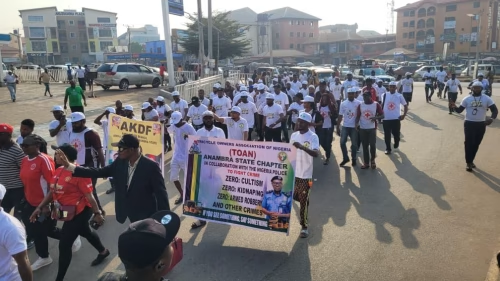 He further called on parents, community leaders, religious bodies, transport unions, and youth groups to join hands with the Police by guiding young people away from cultism and other vices and by promptly reporting suspicious activities to security agencies.