-By Abdul Mahmud
Most Reverend Matthew Kukah has spoken again. This time, he tells Nigerians that the country is not experiencing a Christian genocide. He cites numbers, he questions sources, and he dismisses claims of persecution. He reminds us that genocide is defined by intent, not by pools of blood and burnt out churches. The bishop speaks as if death can be measured only by some theological precision. He speaks as if suffering requires validation from the Vatican. He speaks as if the cries of widows, orphans, and Christian communities terrorised across northern Nigeria are hearsay unless confirmed by his office. Bishop Kukah has carved a niche for himself in Nigerian public life. Once, he poked the eyes of oppressors with fearless sermons and daring speeches. He once seemed a gadfly to power. He once understood the language of moral outrage. Today, he prefers the language of caution. Today, he interprets atrocities for two conveniences: those in charge of the nation-state and the convenience of his new theology. He does not question. He reduces horrors to mere numbers, questioning whether they can even be called horrors without an explicit intent behind them. He argues, with calculated sophistry, that genocide exists only when intent can be proven.
Let us examine his reductionism.
Kukah insists that unless a death can be tied to explicit intent to destroy Christians as a group, genocide cannot exist. He reduces complex realities into legalistic formulas. He discounts decades of chronic violence. He ignores the systematic targeting of communities based on faith. He dismisses eyewitness testimony as anecdotal. He scorns journalistic accounts as unverified. He trusts only his own calculations or those sanctioned by the Vatican. He elevates protocol over pain. He hides behind definitions while lives are extinguished, clergy men taken away or killed. Just yesterday Sunday (November 30-2025), the Cherubim and Seraphim Church in Ejiba, Yagba West Local Government Area of Kogi State was attacked. The pastor, wife and worshippers were abducted. Last week, Venerable Dachi was killed by his abductors – yes, in Bishop Kukah’s home state of Kaduna. Yet, he insists that genocide exists only when intent to destroy a group can be proven. This is a dangerous simplification. The international legal definition, as contained in the 1948 Genocide Convention, does indeed mention intent, but intent is not the sole criterion. Genocide encompasses acts committed with the knowledge that they will destroy, in whole or in part, a group. Systematic killings, forced displacement, destruction of homes, religious sites, and cultural institutions all count. One does not need a signed decree from the oppressor to establish genocide. The logic of intent alone ignores the lived reality of victims. Villages emptied of life, churches torched, children orphaned, communities terrorised – these are visible consequences. To demand proof of a private mental decision by the perpetrator before naming genocide is to demand the impossible. It is to turn suffering into speculation.
Scholars such as Raphael Lemkin, the man who coined the term genocide, emphasised that genocide is a process, a series of actions aimed at annihilating a group. Lemkin spoke of destruction through systematic oppression, not only through explicit declarations of intent. Legal scholars have expanded this understanding to include acts that produce predictable, devastating outcomes for targeted groups. Intent is important, but intent is not an escape hatch for those who reduce horror to definitions convenient to power. When Kukah speaks as though genocide can only exist with direct intent, he removes agency from the perpetrators while dismissing the lived experiences of the victims. He creates a loophole where terror, displacement, and massacres are rendered morally neutral because the legalistic proof of intent is hard to extract. This is not scholarship. It is a moral abdication. It is an evasion of responsibility. It is the language of those who interpret the sufferings of the many for the convenience of a few.
Genocide is not a theological abstraction. It is a social and human reality. It is measured in homes destroyed, lives cut short, and communities erased. It is seen in the fear that spreads across a region when faith alone becomes the marker for death. And no amount of definition by intent can erase these facts. Reducing genocide to intent alone is to argue that mass death is meaningless unless sanctioned by the conscious declaration of the killer. It is to ignore the predictable cruelty embedded in systemic attacks on a group. It is to allow killers to operate under a cloak of invisibility while the world debates whether the numbers and patterns satisfy a technical definition. This is why Kukah’s insistence is not merely wrong. It is dangerous. It is a subtle way to obscure reality and grant impunity. It is an intellectual exercise that leaves victims behind. By anchoring genocide to intent alone, Kukah dismisses history, legal scholarship, and moral obligation. He overlooks the fact that intent can be inferred from patterns of systematic harm. He ignores that international tribunals regularly rely on the consequences of acts to establish genocidal intent. He closes his eyes to the evidence that is in plain sight. He reduces horror to a debate about whether someone, somewhere, consciously decided to destroy Christians. He renders fire and blood secondary to paperwork and memos. In doing so, he betrays not only history but the very communities he claims to serve.
Though Kukah’s transformation from gadfly to the powerful into a defender of obsequious authority seems complete, it is only fitting to contrast him with priests of his kind who stood for truth to the very end. Enter Father Oscar Romero who stood in the pulpit while soldiers murdered the poor outside his window. He did not wait for permission. He did not demand audited statistics. He called out the machinery of terror. He mentioned the names of the dead. He counted their tears, their homes, their broken families. He did not hide behind definitions of intent. He recognised that injustice is self-evident. He acted because silence was complicity. He paid with his life. Contrast Kukah with Paulo Freire, the author of Pedagogy of the Oppressed. Freire understood that education is liberation. He knew that suffering must be named before it can be confronted. He rejected reductionist reasoning that blunted the edge of oppression. He demanded dialogue with the oppressed. He demanded the courage to see power as it functions. He understood that the world is not a ledger of intent. It is a battlefield where the powerful impose structural violence on the weak.
Also, contrast Kukah with South American priests who fought on the side of the poor. They did not measure genocide in intent. They counted what was visible. They confronted killers, militias, and corrupt governments. They challenged impunity. They refused to normalise cruelty. They understood that faith demands solidarity with victims. They embodied that courage that does not calculate permission before speaking truth. They knew that silence is a language that the oppressors understand well.
Kukah’s words on the floor of the Knights of St. Mulumba echo as reductionism. Pure and simple. He cites 1,200 burnt churches every year and asks rhetorically, “In which Nigeria?”. He questions why nobody asked the Catholic Church. He refuses to accept reports from victims, journalists, human rights organisations, or even other Christians. He elevates his own office as the sole arbiter of truth. He reduces genocide to intent alone as if fire, blood, and terror cannot speak for themselves. One wonders how he reconciles his words with his vocation. How does one preach the gospel of love and yet sanitises terror with numbers and legalistic definitions? How does one counsel peace while dismissing sufferings? How does one command moral authority while parroting the language of the oppressors? Once, Kukah feared the powerful. He was our much-sought after and regular speaker at the Church and Human Rights Workshops of the Civil Liberties Organisation in the early 1990s at Ijebu-Ode and elsewhere. Now, he comforts power and the abusers of the right to life. Once, he demanded accountability. Now, he reframes accountability as optional. Once, he was the gadfly. Today, he is the evangelist of the oppressors.
Nigeria does not need semantics.
Nigeria does not need definitions that absolve killers. Nigeria does not need ecclesiastical interpretations of genocide. Nigeria doesn’t need Kukah’s theology of convenience. Nigeria needs truth. Nigeria needs courage. Nigeria needs religious leaders who speak to sufferings, not around them. The women whose husbands were murdered need a voice. The children who saw their schools torched need witnesses. The communities forced to flee their lands need validation. They do not need a lecture on intent.
If genocide is only what one proves in court, then the crime has already won. If suffering must be verified by the Vatican memo, then the dead are silenced twice. If terror requires sanction from hierarchy, then the victims remain irrelevant. This is the dangerous gift of reductionism. It allows moral authority to be divorced from moral courage. It allows words to mask horror. It allows convenience to masquerade as wisdom. Bishop Kukah should remember Romero. He should remember Freire. He should remember priests who risked their lives and comfort to defend the defenseless. The world remembers their courage. The world remembers their solidarity. The world does not remember bureaucratic definitions that sanitise violence. The world does not remember numbers when names are forgotten. The world remembers those who speak for the voiceless, not those who repackage terror as a matter of semantics.
In Nigeria today, churches are burnt. Villages are attacked. Lives are lost. Families are destroyed. Fear spreads. And yet, what we hear from Bishop Kukah is that genocide cannot be named. We hear that intent alone matters. We hear that numbers without Vatican verification are hearsay. His words are a monument to reductionism. His words are a guide for those who would obscure horror. His words betray the moral responsibility of religious leadership when faith demands more, demands courage, demands naming the suffering and demands standing with the victims even when power pressures one to be cautious. Faith is not a tool to sanitise terror. It is a sword against oppression. And that is what Kukah seems to have forgotten.
Bishop Kukah once poked the eyes of oppressors. Today, he seems to shield them. He once championed truth. Today, he sanitises horror. He once had the voice of the oppressed. Today, he theologises convenience. History will judge him. History will remember the voices he ignored. History will remember that genocide is more than intent. History will remember those who spoke for the dead while the living waited for validation from men in suits and pulpits. Nigeria needs more than definitions. It needs courage. It needs truth. It needs religious leaders unafraid to name horror and challenge impunity. Bishop Kukah has chosen another path. He has chosen the path of convenience and of reduction. And that is the tragedy of his moral retreat.
Unfortunately, the retreat is what his New Theology of Convenience is about.
***Abdul Mahmud is the President of the Public Interest Lawyers League (PILL).
Category: People
NAPTIP places Speed Darlington on watchlist
Posted on by admin50
The National Agency for the Prohibition of Trafficking in Persons (NAPTIP) has placed Nigerian rapper Darlington Okoye, popularly known as Speed Darlington, on its watchlist after he reportedly failed to honour an invitation to the agency’s headquarters in Abuja.
The development was announced by NAPTIP’s Director of Legal and Prosecution, Ijeoma Mary Amugo, during a press briefing on Monday to kick off the 2025 edition of the 16 Days of Activism Against Gender-Based Violence.
According to Amugo, the agency had invited the musician to answer questions regarding a disturbing claim he made during a live Instagram session in May. In the viral broadcast, Speed Darlington allegedly boasted about having sexual relations with a 15-year-old girl—an act that amounts to sexual involvement with a minor and falls under NAPTIP’s mandate to investigate.
Fielding questions from journalists, the NAPTIP’s Director of Prosecution said the rapper tried to intimidate the agency.
NAPTIP further said it has not been able to trace Speed Darlington to a known address, making it difficult to get him to answer for the alleged crime.
“So what he did was to preemptively try to intimidate us by going to the social media to say that he wouldn’t come and that he wouldn’t respond to us, that we are kind of sitting on his human rights.
“So we tried our best to physically locate him because you have to locate the suspect before justice will be served,” Amugo stated.
She said, “So, as I’m speaking to you, the last report we have is that he’s outside the country and we have not heard from him yet. We have placed him on watch list. Anytime he enters Nigeria, NAPTIP is going to continue the investigation from where we stopped. So that is the status of the case for now.”
Director-General of NAPTIP, Binta Adamu Bello said the agency would be fine-tuning its implementation strategies to tighten the noose on offenders.
“Nigeria is making efforts to deal with the rising cases of human trafficking across the country.
“However, enforcement remains a challenge, given societal attitudes and cultural norms,” he said.
WEEK FUNSO OWOYEMI LOCKED DOWN LAGOS FOR WIFE, DAUGHTER
Posted on by admin50
By Tunde Olusunle
Thursday January 11, 2024, all roads led to the Holy Trinity Anglican Church, Ikate, Surulere, Lagos, for the formal admission of Otunba Funso Davies Owoyemi, Fellow of the Chartered Institute of Accountants, (FCA), into the septuagenarian rungs. Those who know FDO as acronymed from the initials of his names, know him for his social unobtrusiveness and reticence. This is despite his humongous achievements as an astute professional, conscientious husband, consummate parent, devoted community leader and revered elder statesman. Turning 70 in our kind of environment with its many viccissitudes was worth giving thanks to God and inviting friends and family to join the celebration which was just what Otunba Owoyemi did on that occasion.
Nearly two years later very recently, there was compelling need for a double-barreled encore in Owoyemi’s family. It was the occasion of the engagement of one of his six delectable daughters, Oluwasolape, to her hearthrob, Precious Adeniran, on one hand, and the 70th birthday of his beloved wife, Mrs Rita Abeke Owoyemi, his inseparable partner of five decades. Beginning from Thursday October 30, 2025, therefore, Otunba Funso Owoyemi was going to lock down Lagos for the following half a week to commemorate both landmarks. And from Lagos and beyond, family, friends, associates and acquaintances rallied steadily behind the Owoyemis as they celebrated their own.

The highbrow Rosetree Event Centre, Oniru, Victoria Island, Lagos, hosted the engagement ceremony of Oluwasolape and Precious. Expectedly, it had the orderly, organised imprimatur of FDO, classy without being exhibitionist, the best of Nigerian culture on display as the two youngsters pledged their futures to each other before the world. Lagosians continue to raise the bar of ceremonial sophistry though, ever giving their upcountry guests novelties to think about. Fulfilment was writ large on the faces of the older Owoyemis who have devoted a considerable segment of their more recent years joyfully oversighting the lateral flourish of their family, with the addition of more and more grandchildren.
Sunday November 2, 2025, the Holy Trinity Anglican Church, Ikate, Surulere, was the venue of the 70th birthday thanksgiving of the Owoyemi matriarch, Chief (Mrs) Rita Abeke Owoyemi. It was a packed Sunday service which coincided with the annual “Adult Harvest” of the church, which was going to keep guests and parishioners in church for a long duration. The Rt. Rev. Akinpelu Johnson the Vicar and Archdeacon, led the proceedings. The excitement of celebrating with the Owoyemi family, despite Lagos’ typically unpredictable rain descent, however, overshadowed every proclivity to boredom and restlessness. Guests proceeded to The Podium Events Centre, Lekki, Lagos for the post-thanksgiving reception thereafter.
The socials were a celebration of the finest aspects of Nigeria’s cultures. Otunba Owoyemi’s kinsmen from Yagbaland in the Okun hemisphere in Kogi State, matched their in-laws from Owo in Ondo State with costume, dance and displays. It was a most befitting tribute to the life and multitasking career of a wife, mother, grandmother, sister and aunt, who worked her way to Nigeria’s exchequer, the Central Bank of Nigeria, (CBN), from humble beginnings. Starting out in Secretarial Studies, Mrs Owoyemi with the unflinching support of her redoubtable husband would go on to become a public administrator in her own right. She trained at the Crown Secretarial College and the Pitman’s College, both in London, where she earned a Diploma and a Higher Diploma in Secretarial Studies.

Within the same period, her husband, Otunba Owoyemi earned his badges as a charterered accountant and management professional. The couple wedded in London Borough of Hackney in 1979 and welcomed their first child, Olumuyiwa, one of their two sons, before returning to Nigeria during the regime of President Shehu Usman Shagari in 1980. Mrs Owoyemi began a lifelong career in the CBN in 1981 and grossed three and half eventful decades in service before her retirement at 60 in 2015. She has since redoubled her focus on mentoring and supporting not just her children and their offsprings, but siblings, relatives and adopted children, while also supporting her husband as they both age gracefully together.
Mrs Owoyemi’s commemoration was a harvest of testimonies from a broad spectrum of people and publics she encountered and impacted in a most eventful life. Siblings, childhood peers, schoolmates, colleagues, members of church, voluntary and social organisations, stepped forward to speak so glowingly and eloquently about a rare breed who has lived her life principally for others. The second child of her nuclear family, fate thrust leadership upon her when she lost her older sibling and she had to fill in spontaneously as Numero Uno in the family and pathfinder, a role she has played so very ably and gracefully.
The Owoyemis had very good company at the twin ceremonies. Former Ministers in the administration of former President Olusegun Obasanjo, GCFR at the programme, included Chief and Justice (Mrs) Bayo Ojo, SAN, CON, and Asiwaju and Chief (Mrs) Kola Jamodu, CFR. Prince Olusola Akanmode, Chief of Staff to former Vice President Atiku Abubakar, GCON; Arc Yomi Awoniyi, FNIA, former Deputy Governor of Kogi State; Aremo (Dr) and Chief (Mrs) Yemi Ogunbiyi, former Managing Director of Daily Times of Nigeria Plc, and Senator Musiliu Obanikoro. Rear Admiral Okanlawon Oni, (rtd); AIG Tunji Caulcrick, (rtd); Brigadier-General Benjamin Ipinyomi, (rtd); Ambassador Kayode Shinkaiye; Chief (Mrs) Florence Omotehinwa; Justice Suyi Olateru-Olagbegi and Justice and Mrs Adeniyi Ademola, (rtd), equally added colour to the event.
Mr Eniola Bello, Managing Director of Thisday Newspapers; Mr and Mrs Akin Opeodu, FCA; Mr and Mrs Kunle Owuye; Dr Kola Ibirogba; Otunba Sam Olu Owa; Chief Kunle David; Chief and Mrs Korede Adedayo; Chief Tosin Atewologun; Chief Jide Oni as well as Mr and Mrs Bayo Ibirogba, honoured the milestone. Chief Kayode Soyombo; High Chief Tobi Oduyale; Chief Sanmi Fabode, FCA; Hon Deinde Abolarin; Mr and Mrs Iyiola Oyefeso; Otunba and Mrs Babs Alatise; Engr and Mrs Owa Adewale; Captain and Mrs Ade Olopoenia; Mr and Mrs Uwa Ehanire; Elder Tunde Alogbo and Chief Tunde Odunewu, all kept faith with the Owoyemis. Not forgetting Members of “Klub D’Aspirers” and the “Long Table” respectively.
It was indeed a fitting and memorable week of landmarks which the family of Otunba Funso Davies Owoyemi, FCA, will savour and treasure for decades to come.
Tunde Olusunle, PhD, Fellow of the Association of Nigerian Authors, (FANA), is an Adjunct Professor of Creative Writing at the University of Abuja
13-year-old student, Seth, wins UBA Foundation essay competition
Posted on by admin50
MEET OUR AUTHOR of the WEEK, the award-winning essayist and author, 13 year old
EBUNLOLUWA OLUWATIMILEHIN
By Olasunkanmi Akinlotan
History was made in Lagos on Tuesday, as 13-year-old Ebunoluwa Seth Oluwatimilehin, of Igando Community Senior High School, Igando, a suburb of Lagos, emerged as the overall winner of the 15th UBA Foundation National Essay Competition, thus becoming the youngest winner in the 15 years of the competition.
Ebunoluwa, a public school student in SS2, also emerged as the first male winner in over eight years, as female winners have repeatedly dominated the competition. He clinched the grand prize of N10m educational grant to be used for his future studies at any African higher institution of his choice.
According to a statement from the foundation, an elated Ebunoluwa expressed his joy, stating, “I am incredibly grateful and overwhelmed. This competition has shown me that passion and hard work truly pay off.
It has been an amazing journey that has deepened my love for writing and expressing my ideas.”
The second-place winner, Njoku-Kelechi Emerald of Christian International High School, Owerri, received a N7.5m educational grant, while the third-place prize of N5m educational grant was awarded to Bayero Fatima Auwal of Cornerstone Montessori Schools, Gudu, Abuja.
In addition to the monetary grants for the top three winners, all 12 finalists were awarded brand-new laptops and other educational materials to support their academic pursuits.
The 2025 edition received several thousand entries, with significant participation extending beyond major cities into rural communities across the country.
UBA’s Group Managing Director/Chief Executive Officer, Oliver Alawuba, who commended the Foundation’s 15-year commitment to the initiative, explained the competition’s strategic role in reviving a culture of reading and writing among youth.
Christian families, churches under attack in Nigeria because of their faith, says Nicki Minaj
Posted on by admin50
Popular American rapper Onika Tanya Maraj-Petty, widely known as Nicki Minaj, has spoken out about the rising attacks on Christians in Nigeria.
The award‑winning rapper said Christians in the country are being “targeted and killed en masse,” urging the international community to take swift action to confront extremism and protect churchgoers across the West African nation.
“Christians are being targeted, driven from their homes, and killed. Churches have been burned, families have been torn apart, and entire communities live in fear constantly simply because of how they pray,” the ‘Pink Friday’ rapper said during a speech at the United Nations on Tuesday.
Nicki Minaj’s speech followed an official invitation from the White House to address a UN conference and experts on the alleged ongoing violence against Christians in Nigeria after she came out in support of the decision by President Donald Trump to redesignate Nigeria as a Country of Particular Concern.
During her remarks, the 42-year-old thanked Mr Trump for the steps he has taken so far to put a global spotlight on the situation of Nigerian Christians, noting that freedom of religion and belief should be natural rights.
“I would like to thank President Trump for prioritising this issue and his leadership on the global stage in calling for urgent action to defend Christians in Nigeria and to combat extremism and to bring a stop to violence against those who simply want to express their natural right to freedom of religion or belief,” Nicki Minaj said.
She added, “Music has taken me around the globe. I have seen how people, no matter their language, culture or religion, come alive when they hear a song that touches their soul. Religious freedom means we all can sing our faith regardless of who we are, where we live, and what we believe. But today, faith is under attack in way too many places.”
Speaking further, Nicki Minaj stressed that her decision to champion the situation in Nigeria was not to divide or take sides after receiving criticism over her position, noting that “It is about what I have always stood for my entire career, and I will continue to stand for that for the rest of my life”.
2027 : Utomi, Falana, Bugaje, others form new coalition
Posted on by admin50
A wide-ranging alliance of political figures, civil society leaders, labour representatives and pro-democracy activists has unveiled a new national platform dedicated to overhauling Nigeria’s troubled electoral system.
The initiative, called the Movement for Credible Elections (MCE), emerged from the 2025 National Political Summit on Credible Elections and Political Stability of Nigeria, which took place on Tuesday in Abuja.
The summit was convened by the National Consultative Front (NCFront) in collaboration with the Labour & Civil Society Front (LCSF), drawing more than 600 participants from political parties, public institutions, the private sector, diaspora networks, academia and civic organisations. With the private sector, diaspora networks, academia and civic organisations. With the theme “Critical & Mandatory Constitutional Amendments for Credible Elections in 2027,” the gathering sought to outline a unified national blueprint for electoral reforms ahead of the next general election.
Messages were delivered by former President Goodluck Jonathan; former Vice President Yemi Osinbajo; Kano State Governor Abba Yusuf; former Rivers State Governor Rotimi Amaechi; and former presidential candidate Peter Obi. Also participating were NLC President Joe Ajaero; Pat Utomi, who chaired the organising committee; former Minister and keynote speaker Oby Ezekwesili; Shehu Sani; IPAC Chairman Mamman Dantalle; Gbenga Olawepo-Hashim; and legal practitioner Adewole Adebayo.
Much of the conversation centred on Nigeria’s worsening insecurity and the potential implications for the 2027 polls. Participants cited external warnings — including those attributed to U.S. President Donald Trump — as evidence that the country’s political stability is under serious strain.
Contributors argued that the unchecked rise in banditry, terrorism and violent crime has weakened state authority and created an environment where non-state actors flourish. They warned that the government’s inability to guarantee basic security has left the nation vulnerable to foreign interference.
Delegates also said the deteriorating security climate poses a direct threat to the next general elections, cautioning that many communities could be unreachable unless swift reforms are enacted. Several speakers maintained that credible elections cannot occur when citizens are displaced, intimidated
or denied access to polling centres.
Participants further faulted Nigeria’s political parties, accusing them of weak internal democracy and abuse of candidate-selection processes. According to speakers, these failings have transformed parties into vehicles for transactional politics rather than institutions that produce capable leaders, contributing to a broader governance breakdown.
Stakeholders at the summit jointly denounced the entrenched practices of rigging, vote buying, ballot snatching, suppression of voters, manipulation of results and the extensive litigation that follows nearly every election. They argued that unless these behaviours are eliminated, the integrity of the 2027 elections will remain questionable.
Speakers also noted that public trust in the electoral process has eroded, with outcomes often failing to reflect actual votes cast. Many referenced past instances where judicial rulings — rather than citizen ballots — determined winners, which they said has discouraged voter participation and weakened democracy.
Following extensive deliberations, the summit endorsed a series of reform proposals aimed at reengineering Nigeria’s electoral infrastructure.
A major focus was the need for the Independent National Electoral Commission (INEC) to receive funding directly from the Federation Account to limit undue influence. Stakeholders also called for INEC to adopt an open budgeting system that allows civil society oversight of its expenditures.
Participants insisted that INEC must be constitutionally empowered to prosecute electoral offenders without depending on the Police or the Attorney-General’s office. They urged lawmakers to legalise early voting, diaspora voting, electronic voting and real-time electronic transmission of results, saying these measures would significantly curb manipulation.“Early voting, diaspora voting, electronic voting, and real-time electronic transmission of results should be made legally mandatory to reduce or eradicate manipulation and circumvention of election results,” they said.
Delegates also pressed for reforms to the appointment process of INEC commissioners, arguing that the task should be removed from the Executive and handed to a diverse set of respected national actors. They condemned the current trend where courts decide final outcomes, calling it a distortion that undermines trust.
The summit further sought constitutional provisions for special seats for women and vulnerable groups, stating that: “The National Assembly should be compelled to provide for special seats for women and other vulnerable groups in the constitution to be elected and participate in governance.”
Another proposal was to shift the burden of proof in election petitions from candidates to INEC, which would be required to defend the results it announces.
A highlight of the event was the official rollout of the Movement for Credible Elections (MCE), designed as a broad citizen-driven platform mobilising Nigerians to demand clean elections and counter attempts at manipulation ahead of 2027.
The movement aims to build alliances across regions, professions and political interests, making electoral fraud both socially unacceptable and politically costly.
A 23-member Interim Steering Council was inaugurated to guide the new movement. Pat Utomi will chair the council, with former NLC President Ayuba Wabba serving as co-chair.
Other prominent members include Usman Bugaje (Deputy Chair, North), Nkoyo Toyo (Deputy Chair, South), human rights lawyer Femi Falana, Shehu Sani, Ankio Briggs, Bilikisu Magoro, Ene Obi and Peter Ameh.
The communiqué was signed by James Ezema, who was named Media Coordinator, while Olawale Okunniyi will lead the secretariat.
Additional members — including youth leaders, finance directors, mobilisation coordinators and communication specialists — were also announced. They are Alex Adum; Promise Adewusi, Director of Administration; Chris Uyot, Director of Mobilisation; Hamisu Turaki, Director of Mobilisation; Chris Iyovwaye, Director of Finance; Chris Azor, Director of Mobilisation; Mark Adebayo, Director of Mobilisation; Mustapha Nwaokobia, Director of Communications; Peter Akah, Director of Publicity; Kamal Ahmed, Youth Coordinator; and Hauwa Mustapha, Deputy Head of Secretariat.
(PREMIUM TIMES)
Libya deports 80 Nigerians
Posted on by admin50
Libyan authorities have repatriated 80 Nigerian nationals who were detained in different holding centres across the country as part of an ongoing operation aimed at tackling irregular migration and easing congestion in detention facilities.
The exercise was coordinated by Libya’s Department for Combating Illegal Migration (DCIM) in partnership with the Nigerian Consulate in Tripoli. The deported migrants were flown out of the country via Mitiga International Airport on Wednesday.
Migrant Rescue Watch, an organisation that monitors migrant welfare and human rights issues in Libya, confirmed the development, noting that the deportation was carried out following directives from the Libyan Judicial Police.
In a post shared on X on Wednesday, the group stated, “Judicial Police Dept. on orders of Public Prosecutor’s Office transferred a group of undocumented migrant females of Nigerian nationality to DCIM custody in Tripoli. All females were served with judicial deportation order and are awaiting deportation.”
The organisation added that the latest group of returnees included some migrants previously transferred under judicial orders.
“#Libya 11.11.25 – DCIM with Nigerian consular support, repatriated 80 migrants of Nigerian nationality via Mitiga Int. Airport in Tripoli. The group includes migrants transferred by the Judicial Police who were served with judicial deportation order,” the statement read.
The deportation is part of renewed collaborative efforts between Libyan authorities and diplomatic missions to address the presence of undocumented migrants and improve conditions in the country’s overcrowded detention facilities.
CELEBRATING AMALA DAY WITH FOUNDER, ADEOLA ALAMALA
Posted on by admin50
By Ayo Oyoze Baje
Quote:
“Our goal is to bring the experience of home-cooked Nigerian food to more people, one community at a time. By this, we are
celebrating culture and culinary excellence”-Olorunsomo Smart Adeola, aka Alamalla ( during the event. at the brand-new AAU Campus Outlet in Ekpoma.)
In a vibrant celebration of culture, food, and community spirit, Amala Spot with Adeola Alamala recently hosted the much-anticipated Amala Day 2025, followed closely by the grand opening of its brand-new AAU Campus Outlet in Ekpoma. The events, held on Friday, 31st October, and Saturday, 1st November 2025, with the outlet officially opening on Monday, 10th November 2025, marked a major milestone for the fast-growing local food brand known for its authentic Nigerian dishes and warm customer experience.
Amala Day 2025 wasn’t just another food event it was a festival of culture, taste, and togetherness. For two full days, from 12 PM to 8 PM, the atmosphere at Amala Spot on Sec School Road, Ujemen, Ekpoma, was filled with excitement, laughter, and the irresistible aroma of freshly served Amala, Ewedu, and Gbegiri.
Customers trooped in large numbers, eager to partake in the special 20% discount offered throughout the event. From students to working professionals and local food lovers, everyone came together to celebrate the timeless Nigerian delicacy that unites people across generations.
Olorunsomo Smart Adeola, popularly known as Adeola Alamala, is a graduate of Ambrose Alli University, Ekpoma, Edo State, from the Department of Medical Laboratory Science. Long before his university days, he had already been actively involved in the food industry, where he developed a strong passion for culinary excellence and customer satisfaction.

Adeola Alamala, the passionate founder and face behind Amala Spot, described the event as “a moment to celebrate our roots, appreciate our customers, and introduce new faces to the real taste of Amala done right.”
Guests were treated to well-prepared meals featuring the perfect blend of soft Amala, rich Ewedu soup, and the flavorful Gbegiri option. Many attendees commended the brand for maintaining high food standards and consistency while creating an environment that felt like home.
Beyond the delicious food, Amala Day was also about community connection. Adeola and the team interacted directly with customers, creating a friendly, family-like atmosphere. There were light games, cheerful moments, and even spontaneous dance sessions that kept the energy alive throughout the event.
What truly stood out was the spirit of togetherness Amala Spot successfully turned an ordinary weekend into a memory-filled culinary celebration. Patrons expressed their satisfaction, with many sharing positive feedback on social media and promising to return with friends.
One student attendee commented, “Amala Spot isn’t just a food place anymore; it’s a vibe. Adeola and the team made everyone feel special.”
The two-day festival didn’t just end with satisfied customers it also built momentum for something bigger: the expansion of Amala Spot into new territory.
The Launch of Amala Spot AAU Campus Outlet
Barely a week after the successful Amala Day, Amala Spot with Adeola Alamala took another bold step by launching its AAU Campus Outlet on Monday, 10th November 2025, at 2:00 PM, located before Igbinedion Hostel, AAU Campus, Ekpoma.
This new branch, designed as a “Take-Out Only” outlet, represents the brand’s innovative approach to convenience and accessibility for students and staff within the Ambrose Alli University community. The opening day featured a 10% discount on all take-out orders, drawing a crowd of enthusiastic customers eager to be among the first to experience the new spot.
Adeola Alamala expressed gratitude for the overwhelming support and explained that the AAU Campus branch was inspired by high demand from university students who wanted easier access to their favorite meals. “We realized many of our loyal customers are students who love our Amala but find it difficult to leave campus often. This new outlet brings Amala closer to them,” he said.
The new outlet is a reflection of Adeola Alamala’s long-term vision to make Amala Spot not just a local eatery, but a recognizable food brand across multiple campuses and cities in Nigeria. The Ekpoma expansion shows the brand’s commitment to growth while maintaining its strong focus on taste, quality, and customer satisfaction.
According to Adeola, the success of the Amala Day celebration reaffirmed the community’s love for authentic Nigerian meals and reinforced the need to spread that joy beyond one location. “Our goal is to bring the experience of home-cooked Nigerian food to more people, one community at a time,” he said proudly.

Both the Amala Day event and the new outlet launch demonstrate the brand’s unique philosophy combining culinary excellence with cultural pride. Amala Spot is not just about serving food; it’s about sharing a cultural experience that connects people emotionally to their roots.
By offering discounts, engaging directly with customers, and expanding thoughtfully, Adeola Alamala continues to redefine what a modern local food brand can achieve. The emphasis on trust, transparency, and consistency has earned Amala Spot a loyal following and positioned it as a leading destination for traditional meals in Edo state.
As Amala Spot with Adeola Alamala looks to the future, the brand’s mission remains clear: to celebrate Nigerian cuisine, promote food entrepreneurship, and create spaces where food, friendship, and culture meet beautifully.
The success of the 2025 Amala Day and the launch of the AAU Campus outlet are only the beginning. With the love and support of its growing community, Amala Spot is well on its way to becoming a household name one bowl of Amala at a time.
Kudos to Alamala for his patriotic efforts to bring a local delicacy, such as Amala to the global stage.
Senator Natasha Uduaghan: An icon of selfless leadership
Posted on by admin50
By Ayo Oyoze Baje
Quote:
“I am honoured by the trust you have placed in me, and I am here today to reaffirm my commitment to delivering a future that reflects our shared hopes and aspirations.
-Sen. Natasha Akpoti-Uduaghan ( while commissioning some constituency projects to mark her second year as a senator representing Kogi State Central Senatorial District )
My dear respected reader, faithful fan and concerned Nigerian, let us begin with this apt quote on leadership by the two-time Prime Minister of Britain and acclaimed novelist, Benjamin Disraeli which aptly states that: “I must follow the people. Am I not their leader?” That should be food-for-thought, is it not? Of course,it is. Given the guiding credos in line with the dictates of democracy governance is all about meeting the largely accepted dreams, desires and aspirations of the led majority of people. It is not about self-aggrandizement, satisfying one’s gargantuan greed and crass corruption in high places, as fuelled by the chest-beating and self-righteous political helmsmen and yet want to be feared and worshipped! Not at all. But to God our Creator be all the glory for blessing the good people of Kogi Central Senatorial District, and indeed Nigeria with the exception to that nauseating rule.
She is none other than the bold, brilliant, wave-making and people -loving Senator Natasha Akpoti-Uduaghan, representing that District at the Red Chamber. The news headlines of her recent, epoch-making feat with the commissioning of some Constituency Projects.
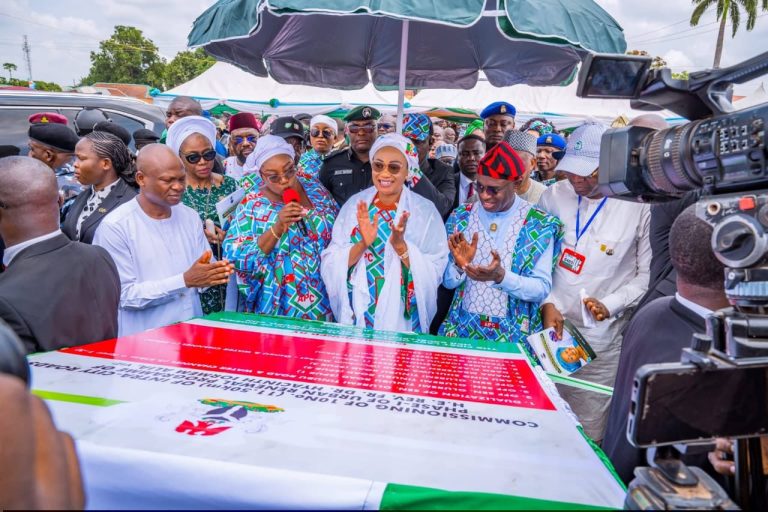
In precise terms, the life-changing projects featured the unveiling of a 50,000-litre capacity solar-powered water reticulation system in Ganaja and solar-powered smart streetlights in Adogo, both located in Ajaokuta Local Government Area. Others included a 20,000-litre capacity borehole in Okene Local Government Area, as well as another 50,000-litre solar-powered water reticulation project in Okaito, Okehi Local Government Area, and others in Adavi Local Government
Area.
in addition, was the commissioning of smart streetlights in Obangede and Eika communities both located in Okehi LGA, as well as in Kuroko community. Other communities that benefited from the Constituency Projects include Ajaokuta village, Nagazi, Oro Layout, Ebogogo, Adogo, Ebiya, Ogaminana, Geregu, Elete,Iruvusechi, and Eika Ohizenyi..Not left out are the 40 solar-powered water projects that have been successfully executed across different communities in Kogi Central Senatorial District. There were the smart markets, a primary healthcare centre, schools, and other landmark constituency developments. And going beyond infrastructural development the senator has also empowered constituents with electric vehicles, cereal grinding machines and other essential equipment designed to promote sustainable livelihoods through small and medium scale enterprises across the District. All these outstanding achievements have triggered the pertinent questions.
For instance, people are asking how she was able to put all these relevant equipment and empowerment tools in place with the funds available to her compared to others who are yet to make the desired impact on the economic and Human Development index,HDI of their constituents? For instance, how do you juxtapose these with that of lawmakers openly distributing bread, rice, noodles, ropes, and wheelbarrows to their constituents, mostly during their campaigns for votes and bragging about such on social media?Does she receive more funds than her colleagues, or has she gone ahead to add more funds from her personal resources?
That reminds one of the wise saying that as a leader: “You manage things; you lead people” as .rightly stated by Rear Admiral Grace Murray Hopper. But there is more to Senator Uduaghan’s landmark projects than some people care to take note of. It should be noted that this is the second edition of her unveiling projects across the senatorial district.


It would be recalled that
she inaugurated legacy projects to mark her first year in office over a year ago. The projects inaugurated included the 1 km road network at the Abdul Azeez Memorial College,AAAMCO, Okene.
The road network was inaugurated by Senate Minority Leader, Sen. Abba Moro, supported by Senate Chip Whip Sen. Tahir Monguno. Other projects inaugurated were remodelled nine blocks of classrooms, four boarding houses, and 5,000 digital learning devices in the same college. The anniversary also included the inauguration of the reconstructed Ihima Police Station, and the distribution of empowerment materials to the needy members of the society.
The Deputy Senate President, represented by Sen. Ladan, described Akpoti-Uduaghan’s first year in office as very effective and praised her efforts to significantly impact her constituents. On his part, Sen. Monguno emphasised the importance of education in a country’s development and commended Sen. Akpoti-Uduaghan’s initiative to digitalise learning in Kogi Central.
Indeed, as Warren Bennis echoed “Leadership is the capacity to translate vision into reality”and that Senator Natasha has epitomized. Said she, during her first year anniversary event,
“When I took on this responsibility, my vision was clear: to create a senatorial district of our dreams, where every child has the opportunity to learn and every young person has access to meaningful employment. To walk the talk on that she has
deployed 5,000 digital learning devices to public primary and secondary schools across Kogi Central, assisted the Universal Basic Education Learning Resource Centre to train teachers and programme the devices with the Nigerian educational curriculum. She has also assisted in constructing a brand-new model primary and secondary school in Osara and facilitated a centre for artificial intelligence and robotics at the Federal College of Education in Okene.
Added to these are the establishment of an automotive mechatronics workshop and cottage automobile workshop at the Technical College in Oboroke. Going forward, the scholarship scheme through the Natasha Foundation that has supported the tuition of 353 vulnerable indigenous students in tertiary institutions nationwide. She has worked tirelessly to attract employment opportunities for various graduates and facilitate capacity-building training and empowerment programs for thousands of beneficiaries from the District.
The facilitating fact that some of her great achievements were recorded while she was on suspension due to the Akpoti-Akpabio saga shows her clear understanding of achieving success in life as a hurdle race. In spite of the cheers and jeers of the spectators Natasha kept scaling over all the hurdles of hate, threats and intimidation from her unrelenting traducers. She was focused fully on the finishing line. As Harold Johnson,the late publisher of ‘Ebony Magazine’ rightly noted: “The greater the obstacles you overcome in life, the greater the glory you achieve.
Of great and enduring significance is that she loves to give freely to the needy members of the society. She is therefore, “protected from the enemies” as enshrined in the Biblical Book of Psalm 41 verses 1-2.
Love or hate Natasha, she has come to redefine the crude concept of the Nigerian variant of democracy where might – is – right to that of giving a listening ear to the needs, the aspirations and cries of the people the leaders claim to serve. All the projects were not only based on her sustained interaction, engagement and the rich and robust discourse she had with her constituents but equally spread across the five local governments of the Central Senatorial District.
As Max DePree clearly stated: “The first responsibility of a leader is to define reality. The last is to say thank you. In between, the leader is a servant.” That aligns with the root linking of democracy as it was with the Ancient Greece back in 500 BC when the led majority got fed up with both oligarchy and aristocracy.and changed the narrative to government of the people by the people and for the people. That is not rocket science.
In response to her sterling performance Dr. Tom Ohikere, a former Commissioner of Information in the state who hails from Okene LGA has this to say: “Senator Natasha Akpoti-Uduaghan is an effective and efficient parliamentarian with unprecedented and verifiable achievements since the last two years in the Red Chamber”. While Zekeri Saidu Bala from Ero in Ajaokuta LGA praised her projects and requested for more for his people, Nasiru Onubaiye from Okehi LGA stated that:”She is first amongst her colleagues. Her legacy projects are unique and the best.To Senator Natasha Akpoti- Uduaghan, we wish you all the best in the years to come.
Great Loss As Son of Redeemed Church Founder Dies Suddenly
Posted on by admin50
Pastor Ifeoluwa Akindayomi, the last born of the founder of the Redeemed Christian Church of God, Pa Josiah Akindayomi has died. He was 62 years old.
He died on Sunday November 2..
His death came about 45 years after that of his father and 7 months after the transition of his elder brother, Pastor Kolade Akindayomi, who died on May 4 this year.
A close family friend of the late Ifeoluwa Akindayomi told Church Times that his death was shocking and too sudden.
‘Nobody would have thought he would die barely 24 hours after he was chairman of a wedding ceremony.
with his business and the bit he could do in God’s vineyard.” .said Akinyemi
He noted that his greatest strength was being able to keep his friends and his love for people.. ‘He had a good human relations and was doing quite well. The last time I saw him was during the convention of the RCCG. His house was home to many peopley who came for the convention. I am really devastated to hear of his death.’ said Akinyemi.
Recalling their days together at Molusi College, Ijebu Igbo, Ogun State, Akinyemi said, ‘He was a perfect gentle man. He picks his words and was generally pleasant. There was no air around him.. he was just like any other student.
“He did not go about bragging. As a pastor he truly loved God. He would not fight for anything. One would have thought he would have risen to a very high position in the church. But I guess he must have decided by himself to keep low and not agitate for anything.I am personally going to miss him.”
(Church Times Nigeria)
This is so sad and it’s a huge loss to the redeemed Christian church of God.
He was planning to relocate to Canada,given a PR ( permanent resident) but death denied him the opportunity of reuniting with his family.
The General Overseer, Pastor E.A Adeboye has not issued any statement as at the time of filling this report.