
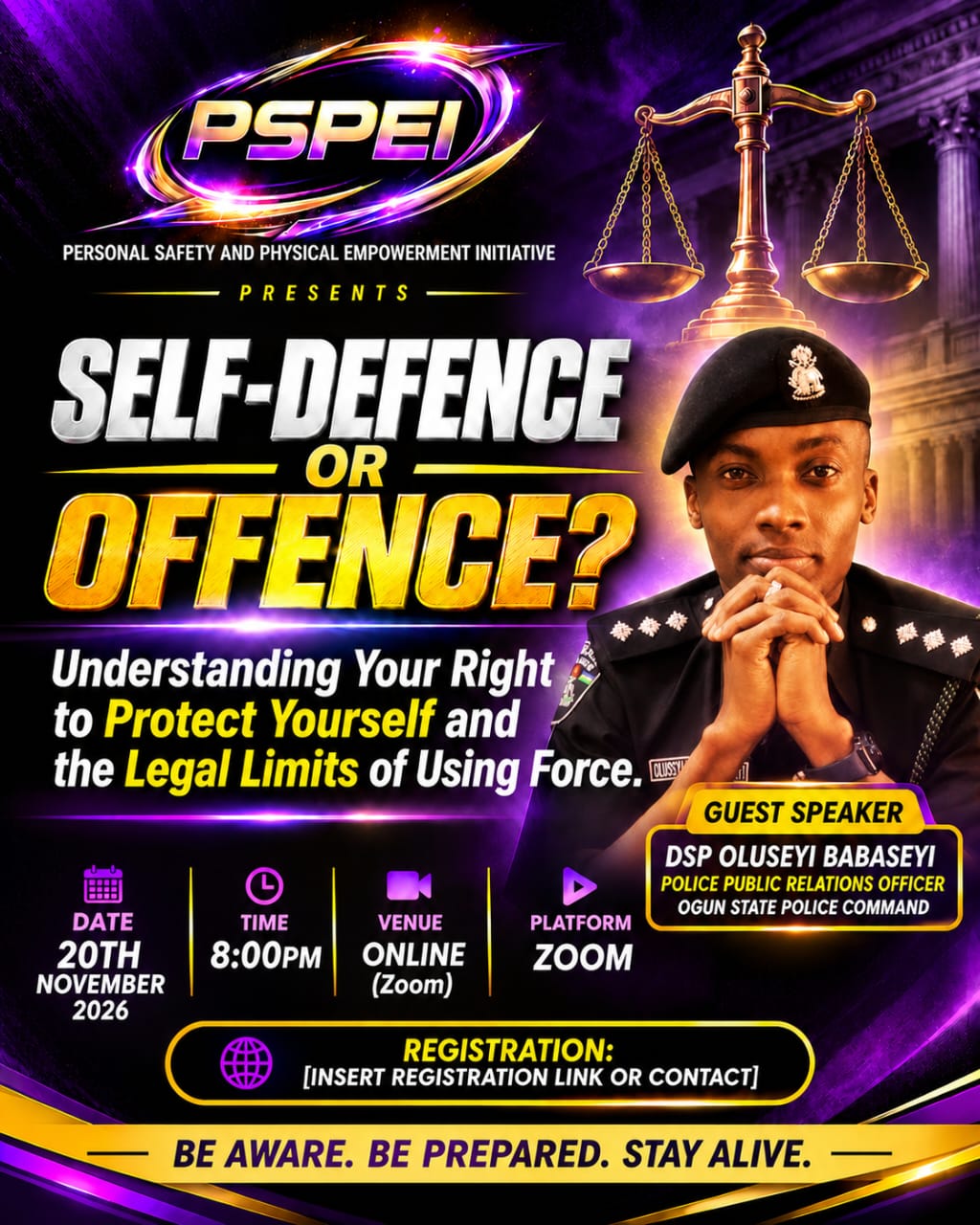
Know Your Rights. Know Your Limits. Protect Your Future.
A PRACTICAL LEGAL AWARENESS LECTURE FOR YOUNG NIGERIANS
Facilitator: DSP Oluseyi B. Babaseyi, anipr
Police Public Relations Officer, Ogun State Police Command
INTRODUCTION:
WOULD YOU KNOW WHAT TO DO?
Imagine someone slaps you during an argument. Would you stab the person?
An armed robber breaks into your house and threatens your life. Must you simply surrender?
Someone snatches your phone and runs away. If you catch that person, do you have the right to beat them?
You witness a group of people beating a suspected thief. Should you join them?
These are real-life situations that young Nigerians may encounter. How we respond can determine whether we remain victims, protect ourselves lawfully or become offenders ourselves.
Today, we are discussing an important subject: SELF-DEFENCE OR OFFENCE?
As a Police officer and legal practitioner, I want you to understand one fundamental principle:
Nigerian law recognises your right to defend yourself, but it does not give you an unlimited licence to use violence.
The purpose of this discussion is not to teach you how to fight, but to help you understand your rights, make responsible decisions, protect your life and avoid actions that could jeopardise your future.
WHAT DOES NIGERIAN LAW SAY ABOUT SELF-DEFENCE?
Self-defence means using legally justified force to protect yourself or another person against an unlawful attack.
In Nigeria, this right is recognised by law.
Three important legal provisions you should know are:
Section 33 of the 1999 Constitution: Protects your right to life and recognises the use of reasonably necessary force in circumstances permitted by law for the defence of a person or property.
Section 286 of the Criminal Code: Recognises the right to defend yourself against an unprovoked unlawful assault, subject to the conditions prescribed by law.
Sections 287 and 288 of the Criminal Code: Address self-defence in circumstances involving provoked assaults and assistance given to another person lawfully defending themselves.
In simple terms, you have a right to protect yourself, but your response must remain within the limits of the law.
WHEN DOES SELF-DEFENCE BECOME AN OFFENCE?
Let us consider situations that are familiar to young people.
Scenario 1: Someone slaps you during an argument.
You pick up a bottle and smash it against the person’s head.
Can you automatically claim self-defence? No. The force used may be excessive and could expose you to criminal liability.
Scenario 2: An armed robber attacks you.
Someone threatens to shoot you during an armed robbery, and you use necessary force to protect your life.
This may qualify as lawful self-defence, depending on the circumstances and the requirements of the law.
Scenario 3: Someone steals your phone.
You pursue the person, recover your phone and continue beating the suspect.
You may have turned a property-related incident into an assault offence. Recovering your property does not give you the right to punish someone.
Scenario 4: You witness a woman being violently attacked.
You intervene to protect her.
The law recognises the defence of another person, provided your intervention and the force used are legally justified.
Scenario 5: An attacker runs away.
You pursue the person and inflict injuries out of anger.
That is ordinarily retaliation, not self-defence. Once the immediate danger has ended, the justification for defensive force may also end.
Remember: Self-defence is about stopping danger, not settling scores.
FIVE THINGS EVERY YOUNG NIGERIAN SHOULD KNOW
* Avoid unnecessary fights. Do not allow insults, pride, peer pressure or social media arguments to put your future at risk.
* Do not carry weapons to intimidate people. A simple disagreement can become a serious criminal matter.
* Use only legally justified force. The nature of the threat and the necessity of your response matter.
* Reject jungle justice. A person suspected of stealing is not automatically guilty.
* Report threats to the Police. Do not take the law into your own hands.
WHAT IF YOU HAVE TO DEFEND YOURSELF?
If you find yourself in a dangerous situation:
* Prioritise your safety and escape if reasonably possible.
* Avoid escalating the confrontation.
* Use only force that is legally justified in the circumstances.
* Stop when the immediate danger ends.
* Seek medical assistance for anyone injured.
* Report the incident to the Police.
* Preserve relevant evidence and identify witnesses.




* Seek legal assistance where necessary.
If an incident results in serious injury or death, understand that the Police may investigate the circumstances, even where self-defence is claimed.
An investigation does not automatically mean guilt.
KNOW YOUR RIGHTS WHEN DEALING WITH THE POLICE
Your rights do not disappear because you have been arrested or invited for questioning.
The Nigerian Constitution provides important protections:
* Section 34: Right to dignity of the human person and protection against torture and inhuman treatment.
* Section 35: Right to personal liberty and safeguards relating to arrest and detention, including the right to remain silent or avoid answering questions until after consultation with a legal practitioner or another person of your choice.
* Section 36(5): Presumption of innocence until proven guilty.
The Police have a responsibility to investigate offences, protect lives and maintain public order. Citizens equally have a responsibility to cooperate with lawful investigations.
Being arrested does not automatically make you guilty. Equally, claiming self-defence does not automatically exempt you from investigation.
LET US HAVE A CONVERSATION
I want you to think about these questions:
* If somebody slaps you, should you retaliate with a weapon?
* If an armed robber attacks you, should you surrender or defend yourself?
* If someone steals your phone, do you have the right to beat the suspect?
* Should citizens take the law into their own hands when they catch suspected criminals?
* Is walking away from a fight a sign of weakness?
* What would you do if you witnessed someone being violently attacked?
There are no foolish questions in this discussion. The objective is to understand the law and make better decisions.
CONCLUSION: DEFEND YOUR LIFE, NOT YOUR EGO
Young people, your life is valuable. Your freedom is valuable. Your education, career, family and future are worth protecting.
Do not allow a moment of anger to destroy years of hard work.
Not every insult deserves a response. Not every provocation deserves a fight. Not every confrontation requires violence.
Sometimes, walking away is wisdom. Sometimes, reporting is courage. And when faced with an immediate unlawful threat, defending yourself may be necessary.
But always understand the limits of the law.
The strongest person is not necessarily the one who can fight everyone, but the one who knows when to walk away, when to seek help and when to act within the law.
Defend your life, not your ego. Protect your future, not your pride.
BE AWARE.
BE PREPARED.
STAY ALIVE!
DSP OLUSEYI B. BABASEYI, anipr
Police Public Relations Officer
Ogun State Police Command
Eleweran, Abeokuta, Ogun State.
Legal note: This lecture is for public education and awareness. The application of self-defence depends on the facts of each incident, the applicable Nigerian law and judicial interpretation. For Ogun State, the applicable state Criminal Code Law should be consulted alongside the Constitution and relevant judicial authorities.